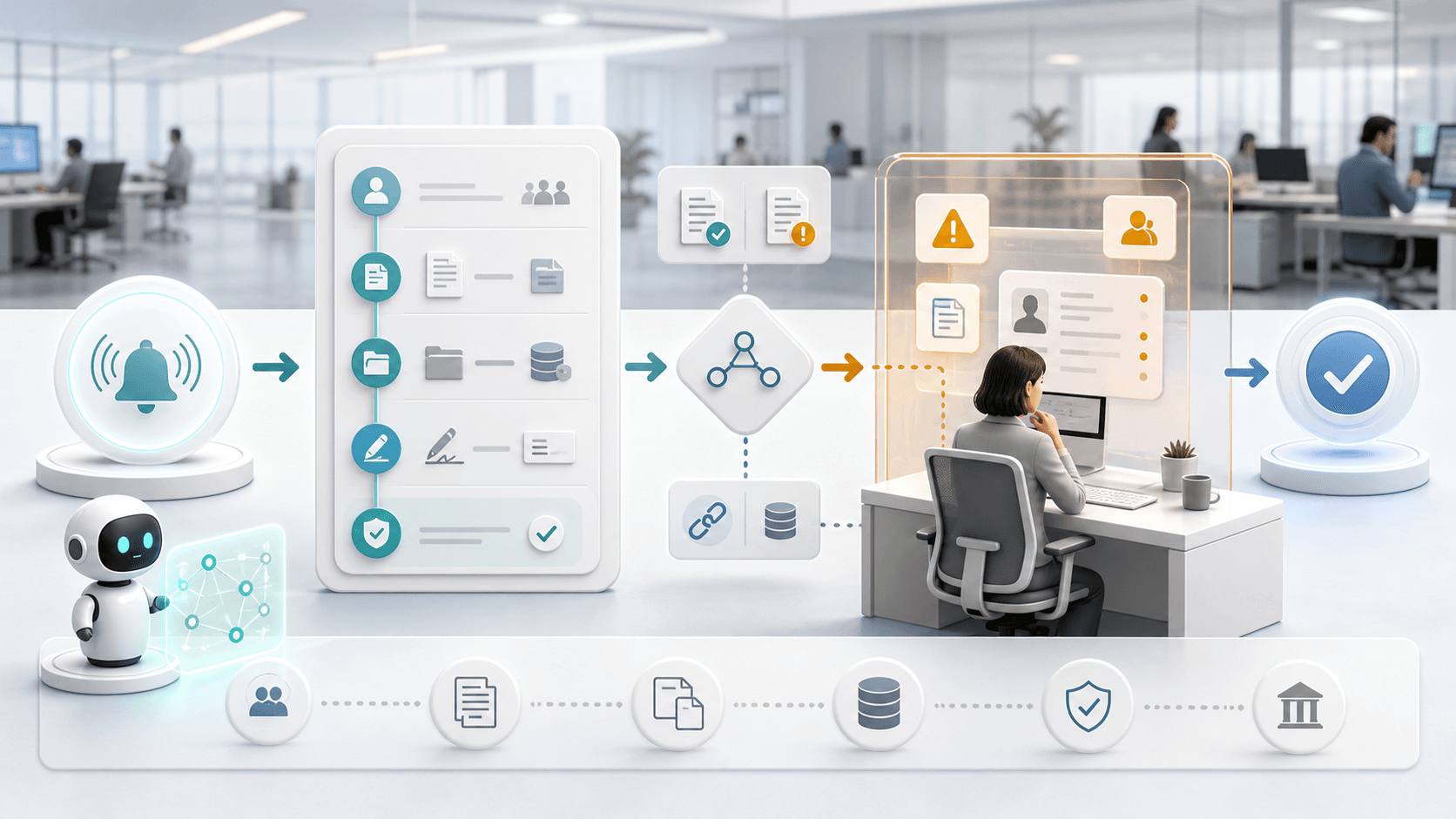
On 23 July 2026, the Government of Ajman Media Office announced that a government trade-licence renewal had been completed with Agentic AI in a proactive, headless service model. Gulf News independently reported that the first phase prepares the renewal journey before expiry and can coordinate a related commercial-lease renewal when it is required.
The useful CRM lesson is not “make every renewal autonomous.”
It is this:
A proactive AI service needs an exception route that is as deliberate as its straight-through route.
That changes the design question for teams building customer, member, subscriber, permit, contract, or service-renewal workflows. The important work is no longer only sending a reminder or opening a task after a deadline has passed. It is preparing a journey early, connecting the dependent records, and making sure a person takes over whenever the system reaches a decision that changes the customer's legal, commercial, or service position.
What the current event establishes
The two sources support three current facts:
- Ajman announced completion of a government trade-licence renewal using Agentic AI on 23 July 2026.
- The first phase concerns upcoming trade-licence renewals and notifies the customer before expiry through a unified government service journey.
- When a valid commercial lease is also required, the journey can coordinate that dependency before renewal continues.
The public reporting also describes approvals, governance, trust, accountability, data protection, continuous monitoring, and human oversight as part of the operating model.
Those are reported facts about this public-service launch. They do not prove that every proactive renewal should run without review, that every organisation has the same data quality, or that an AI system can decide eligibility on its own.
The service starts before the customer asks
Many CRM renewal flows still begin with an inbound action:
- a customer asks why a renewal failed;
- a staff member notices an approaching expiry date;
- a support team looks across several systems for prerequisites;
- someone sends a reminder after the original window has already narrowed.
That is a reactive queue.
A proactive renewal service begins with a known future event. It can detect that a renewal window is approaching, collect the related record history, check whether the normal route is available, and prepare the next step before the customer needs to search for it.
This is a meaningful difference from a chatbot. A chatbot waits for a question. A proactive service journey creates a reviewable unit of work around a known need.
For a CRM team, that unit may be a contract renewal, membership continuation, licence review, annual compliance action, subscription change, or scheduled service visit. The system should identify the customer and upcoming milestone, but it should also keep the conditions for the normal route visible.
The central CRM object is the exception
The straight-through path is often easy to describe:
Renewal is due, all prerequisites are valid, the customer receives the next step, and the journey continues.
The harder and more valuable design is the exception.
An exception exists when the route cannot safely continue as planned. A required document may be missing. A linked agreement may have expired. A customer may be in a disputed state. A policy rule may need interpretation. The record may belong to the wrong account. A requested outcome may be legally or commercially binding.
If those cases are only described in notes or buried in an AI prompt, the team has created a faster way to lose context.
Instead, make the exception a deliberate CRM work item with a plain operational purpose:
| Service state | Who acts next | What AI may do | What remains human-owned |
|---|---|---|---|
| Normal route available | Workflow owner | Prepare the journey and customer-ready explanation | Maintain the approved rules and monitoring |
| Prerequisite missing | Case reviewer | Identify the missing dependency and draft a request for information | Decide whether the condition is satisfied or an alternative route applies |
| Conflicting record or policy | Responsible decision-maker | Summarise the known facts and show the conflict | Interpret the rule, choose an outcome, and approve any binding communication |
| Customer challenge or complaint | Service owner | Retrieve the journey history and prepare a response draft | Decide the remedy, commitment, and final message |
The table is not a field checklist. It is a division of responsibility. It tells the system when to stop being a journey engine and become a preparation tool for a person.
When a dependency changes, stop the straight-through path
The Ajman example is useful because the public reporting describes a dependent commercial-lease renewal. A renewal is not a single date in one record when another valid relationship must be confirmed first.
The same pattern appears in ordinary CRM work:
- a contract extension depends on a current security review;
- a member renewal depends on a completed payment or consent update;
- a service appointment depends on a valid address, asset, or coverage record;
- a customer success renewal depends on a usage, entitlement, or account-ownership check.
AI can help link these records and prepare the order of work. It should not silently assume that a missing dependency is acceptable.
Use an explicit rule: when a prerequisite is unknown, conflicting, expired, or outside the approved policy, the automated path stops and creates a human-owned exception.
That rule is simpler to explain to customers and staff than a promise that an agent will “handle everything.”
Give people the decisions that matter
Human oversight works best when it is specific. “A person is in the loop” is too vague if nobody knows which decision belongs to them.
For proactive renewal services, keep these decisions human-owned whenever they apply:
- whether the customer is eligible under the current rule;
- whether a missing or conflicting prerequisite can be accepted, corrected, or waived;
- whether a special commercial, legal, or service commitment should be made;
- whether the final customer-facing outcome is accurate and appropriate.
AI can still create real value before that point. It can detect an approaching window, organise the service history, connect known prerequisites, identify what is unresolved, and prepare a clear draft for the reviewer. The reviewer then makes a decision with the relevant context instead of reconstructing the journey from separate systems.
Start with one upcoming-renewal journey
Do not begin by connecting every deadline in the company to an AI agent.
Choose one recurring service where three things are already clear:
- the upcoming milestone is reliable enough to detect;
- the normal route has a small number of known prerequisites;
- one person or team can own the exception outcome.
Then measure two outcomes separately:
- how many customers completed the normal journey without unnecessary effort;
- how quickly and consistently the team resolved the exceptions.
Those measures avoid a common mistake: calling a service successful just because fewer people had to ask for help. A good proactive service should make the normal route easier and make the difficult cases more accountable.
Takeaway
The current Ajman launch is a practical public example of a broader CRM shift: AI can prepare a customer journey before the customer asks, coordinate known dependencies, and keep the routine path moving.
But a trustworthy service is defined by what happens when the route is no longer routine.
Build the exception route first: show the unresolved condition, assign the responsible person, preserve the evidence, and let that person approve the decision that changes the customer's outcome.
If you are designing a reviewable CRM and AI workflow for proactive service, contact us to discuss the first journey worth testing.